Last updated 2026-08-18
TL;DR
Yes. Commercial cut and wrap for hunter-owned meat in Arkansas requires a state permit or grant of inspection from the Arkansas Department of Agriculture's Livestock and Poultry Division. The custom exempt permit fee changes, so confirm it before budgeting. The real first-year money goes to cooling, wastewater, and buildout. Approval is weeks to months, never guaranteed.
Do you need a license for cut and wrap in Arkansas?
Yes. If you cut, wrap, or process meat for someone else in Arkansas, even if the customer owns the deer and no meat is sold, you need a state permit or grant of inspection. Arkansas runs a state meat and poultry inspection program through the Arkansas Department of Agriculture's Livestock and Poultry Division, often still called the Livestock and Poultry Commission by older operators [1]. The exact approval you need falls into two buckets. Custom exempt covers hunter-owned and owner livestock that stays out of commerce. State or USDA inspection covers anything that enters retail sale [2].
There's a persistent myth that a deer processing shed somehow operates outside the state system. It doesn't. The federal custom exemption removes continuous USDA inspection, but Arkansas law still puts you on the division's radar. The product must be marked "Not for Sale", records must track whose animal the meat came from, and the facility still gets sanitized like a real plant [3][4]. If you skip this, the first cooler full of meat is a business record, not a side project.
So the real answer is yes, but not every operation needs a full grant of inspection. Most hunters' cut and wrap shops in rural Arkansas are custom exempt facilities, not inspected plants. If you are still at the planning stage, read how to start cut and wrap in Arkansas before you pour concrete.
What is an Arkansas custom exempt cut and wrap permit?
Custom exempt means the customer owns the live animal or legally tagged game before it arrives, and the finished meat returns only to that customer and their household. One Arkansas Department of Agriculture phrase is worth writing on the cooler door: "Not for Sale" [4]. Federal rules exclude that work from continuous federal inspection under 9 CFR 303.1 because the meat is not entering commerce [3].
Arkansas still wants a custom exempt facility documented. You'll file an application with the Animal Health or Meat Inspection staff, keep a record of each animal owner, and maintain a sanitation plan. Some facilities also handle fish or poultry under the same umbrella, but poultry and game birds can trip state and federal lines differently. When someone asks whether they need a custom exempt permit or a full state inspection grant, the deciding question is always: will the customer sell any part of the finished product? If yes, custom exempt ends and a grant of inspection begins [2].
Treat custom exempt as a license to return meat, not to sell meat. That distinction is what keeps the annual fee small and the inspection burden manageable.
Which agency actually regulates cut and wrap in Arkansas?
The Arkansas Department of Agriculture, Livestock and Poultry Division, Meat and Poultry Inspection Program handles meat and poultry inspection, including custom exempt facilities [1]. The Arkansas Department of Health can also enter the picture when food is sold or served on-site, and local health authorities may require a food establishment permit [5].
This split confuses people, and it should. If you only cut and wrap hunter-owned deer, you are generally on the Department of Agriculture side. If you add retail counters or ready-to-eat products, the Department of Health sees the room. Some counties will still require a local food service permit even for custom exempt processing simply because they classify the activity as food processing. Call the county before you buy the building.
The USDA Food Safety and Inspection Service is your federal partner if you want a grant of federal inspection. For most Arkansas deer processors, USDA never inspects the plant, but its rules still mark the boundary around what custom exempt means [2]. If you are comparing state rules, cut and wrap license in Alabama shows the same custom exempt and inspected split.
How much does cut and wrap cost in Arkansas?
You won't find one honest number for cut and wrap cost in Arkansas because the state permit fee is a small line item that the division updates, and local fees vary. What you can verify today is the paper path around the business itself. An Arkansas LLC articles filing costs $45 online or $50 paper, and the LLC minimum annual franchise tax is $150 [6]. A sales tax permit from the Arkansas Department of Finance and Administration has no application fee [7].
The real first-year cost is in the physical plant. A used walk-in cooler, a stainless hand sink, a commercial grinder, and a mop sink will outrun every fee by a wide margin. I'd budget the physical room before the paperwork because a garage conversion that meets wastewater and handwash rules costs more than people think. A cheap trailer job usually fails the wastewater or handwash review.
The custom exempt annual permit fee should be confirmed with the Livestock and Poultry Division before you write the application check. Do not take a fee screenshot from a forum as current. Arkansas agencies update published schedules, and the county can add another permit on top. For a detailed cost breakdown pattern, read cut and wrap cost in Alabama.
How long does cut and wrap take in Arkansas?
Plan for weeks to months, not a same-week permit. The application itself is short once your facility is ready, but the pre-application steps eat the calendar. Local building and wastewater review, floor plan changes, cooler install, and inspector scheduling all stack.
The state does not publish a guaranteed clock for custom exempt approval. I won't give you a fake 30-day promise. The practical pattern in Arkansas is that an existing clean building with approved plumbing can move through the state and county steps in a few weeks, while a new pole barn may take the better part of a year before the first deer is accepted. Confirm current review times with the Arkansas Department of Agriculture before you sign a lease [1].
What you can control: submit complete floor plans the first time, place the hand sink within line of sight of the processing area, and have hot water before the inspector walks in. Missing hot water is the single biggest avoidable delay in a first inspection.
What does an Arkansas cut and wrap inspector look for?
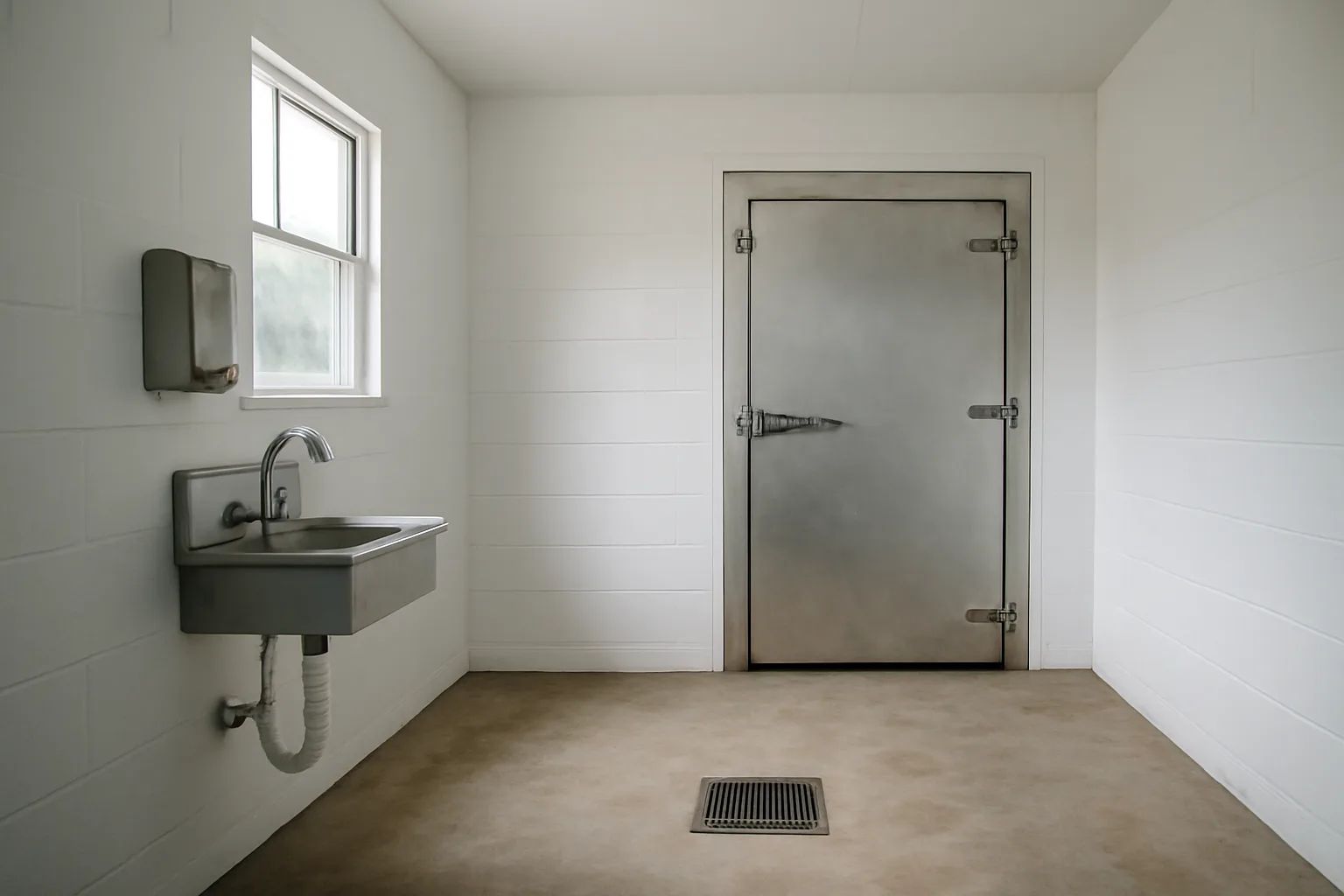
Think sanitation, not paperwork theater. Arkansas meat inspection wants washable walls and ceilings in processing rooms, a dedicated hand sink with hot and cold water, potable water, a floor drain that doesn't pool, and coolers holding 40°F or lower [1][5]. You'll need testable thermometers and a way to separate different owners' game.
The "Not for Sale" marking matters as much as the drain. Custom exempt meat must be marked or labeled so it cannot be confused with inspected product [3]. Inspectors also look at whether wild game and domestic livestock are handled together without cross-contamination. In Arkansas, feral hog processing can carry different rules depending on the source and testing status, so ask before mixing species.
If you're converting a home garage, the inspector will usually reject residential carpet, open ceiling joists, and a bathroom sink used for handwashing. The cheapest fix is often a dedicated room with smooth surfaces and a small water heater dedicated to the hand sink.
What other licenses and permits are needed beyond the cut and wrap permit?
An Arkansas cut and wrap business is still a business. Register your LLC or corporation with the Arkansas Secretary of State [6]. If you use a trade name, file it there too. Get a sales tax permit from DFA even if you only custom process, because you may need to show it for equipment purchases or retail odds and ends later [7].
Local permits vary by county and city. Some counties require a local business license; others require a food establishment permit from the Arkansas Department of Health [5]. If you plan to put in a septic tank or spray field for processing wastewater, the Arkansas Department of Environmental Quality may also have a permit path. Do not assume the meat inspector covers sewage. They don't.
A lot of new owners forget the sales tax permit because custom processing is a service. Arkansas taxes many processing services, and a customer may ask for a receipt. Having the permit in place is cheaper than fixing a DFA issue after you have been operating.
Arkansas custom exempt vs state-inspected vs USDA-inspected
Not every Arkansas cut and wrap shop has the same inspection world. Use this table before you decide what to apply for.
| Type | Who inspects | Can you sell meat? | Product mark | Common Arkansas use |
|---|---|---|---|---|
| Custom exempt | State registration, no continuous inspection | No, owner use only | Not for Sale | Deer and livestock for the owner |
| State inspected | Arkansas Department of Agriculture | Yes, within Arkansas | Arkansas inspected | Small meat shops selling in state |
| USDA inspected | USDA FSIS | Yes, interstate and export | USDA mark of inspection | Larger or regional plants |
The labels and legal rights are not interchangeable. A custom exempt shop that sells one package of deer sticks has crossed the line, and the state can treat that as meat entering commerce without inspection [2][3]. When in doubt, apply for the grant of inspection before you sell, not after.
What happens if you cut and wrap in Arkansas without a permit?
The state can issue a stop-sale or stop-processing order, and you risk fines under Arkansas meat inspection law. More practically, any meat you produced has no legal status. You cannot sell it, donate it to a food bank as inspected product, or use it in a retail case. The "Not for Sale" stamp is the only reason custom exempt product has legal cover, and it only works when you operated with the required state paperwork [3][4].
Operators rarely get caught during deer season because they kept to themselves. They get caught after a neighbor complaint, a fire or injury report, or a local health referral. At that point the corrective work usually costs more than the application and the drain repair would have cost in the first place.
Don't confuse low visibility with low enforcement. Arkansas has a state inspection program and field staff who understand custom exempt boundaries [2]. Your best legal position is a paper trail that starts before the first animal arrives.
How to start a cut and wrap operation in Arkansas the right way
Step one: call the Arkansas Department of Agriculture meat inspection program and ask for the custom exempt application and current fee. Step two: sketch the floor plan before you buy equipment. Step three: form the LLC or file your DBA, then get the sales tax permit [6][7]. Step four: fix the physical space to match handwashing, drainage, cooling, and finish requirements. Step five: schedule the first inspection with the state and any local authority [5].
Do not buy the $12,000 walk-in cooler before the wastewater question is answered. Do not pour concrete before the floor plan has a written okay from the agency. The paper path is not the delay, the room is.
If you're comparing nearby states, cut and wrap license in Alabama follows the same sequence. The regulatory names change, but the concrete and drains don't.
What a first-year Arkansas cut and wrap operation should actually buy
Buy sanitation first, not a bandsaw. A stainless hand sink with pedal controls, a mop sink, a smooth floor, a water heater sized for continuous handwashing, and a good drain mat will do more for approval than a new grinder. Buy a commercial dial thermometer or a thermocouple and check it against ice water every week.
After the room is right, buy a HACCP-style record system and deer-season intake forms. That's where a $179 kit like CutWrapPath's at /start can fill a specific gap if you need forms and a basic HACCP plan without hiring a consultant. It doesn't replace the Arkansas permit and it doesn't make a bad drain legal. Use it after the application is in, not as a substitute.
Skip the custom logo order and the color-coded tubs until the first inspection is passed. You will need cleanable tubs, but they don't need your brand name on them to get an inspector's signature.
Common mistakes in Arkansas cut and wrap that waste money
Overbuilding the retail case before the permit, putting the hand sink across the room from the cutting table, using a residential water heater, and assuming deer season volume will pay for a new metal building are the usual mistakes. Another one: taking the term custom exempt as no rules. Federal inspection is exempted, state registration is not [3][4].
If I were starting today, I'd rent a small existing meat room or a food-grade cabin with a floor drain before I built new. Arkansas has rural buildings that no longer operate as meat shops. Reopening one creates a faster inspection because the bones of the facility are already right. You'll still need a current permit, but the physical work shrinks.
The worst waste is a too-early equipment loan. A finance company will sell you a cooler package before the wastewater authority has even looked at the site. That's backwards. No piece of stainless steel fixes a failed drainfield. For renewal season, cut and wrap renewal in Alabama is a useful reminder that the permit is annual, not forever.
Frequently asked questions
Do you need a license for cut and wrap in Arkansas?
Yes. Commercial cut and wrap for another person's meat requires either a custom exempt permit for owner-use product or a grant of inspection for meat that enters retail sale. The Arkansas Department of Agriculture's Livestock and Poultry Division handles both paths. Local health or business permits may also apply.
How much does cut and wrap cost in Arkansas?
There is no single state price. The custom exempt permit fee is set by the Arkansas Department of Agriculture and changes, so confirm it before budgeting. Fixed business paper costs include $45 online or $50 paper for LLC filing and a $150 minimum annual LLC franchise tax. Sales tax permit filing has no fee.
How long does cut and wrap take in Arkansas?
The state does not publish a guaranteed time for approval. An existing clean building with plumbing can sometimes clear state and county review in weeks. A new build commonly takes months because building, wastewater, cooler installation, and inspector scheduling all add time. Submit complete plans and have hot water ready.
Can I process deer for other people in Arkansas without USDA inspection?
Yes, if you operate as a state-recognized custom exempt facility and the meat is returned only to the owner, their household, and nonpaying guests. The product must be marked "Not for Sale". Selling any part moves you outside custom exempt and requires a state or USDA grant of inspection.
Is a custom exempt permit the same as a food service permit?
No. A custom exempt permit covers returning meat to the animal owner without sale. A food service permit from the Arkansas Department of Health or a local health authority covers retail food activity. Some counties still require both depending on how they classify the facility.
Does the Arkansas Department of Health or Department of Agriculture handle cut and wrap?
The Arkansas Department of Agriculture's Meat and Poultry Inspection Program handles meat processing and custom exempt facilities. The Arkansas Department of Health enters when food is sold, served, or regulated as retail food. A county may also issue local health permits.
Do I need a HACCP plan for custom exempt deer processing in Arkansas?
State custom exempt facilities do not operate under full USDA HACCP requirements the way inspected plants do, but you still need sanitation records, temperature logs, and a written way to track owner meat. A basic HACCP-style plan helps an inspector see that you control the process.
Can I sell cut and wrap meat from my custom exempt facility?
No. Custom exempt product is legally marked "Not for Sale" and cannot enter commerce. To sell meat, including deer sticks or retail cuts, you need a state or federal grant of inspection before the sale. Selling from a custom exempt shop is a serious compliance line to cross.
Does Arkansas require a separate license for wild hogs?
Wild hog processing can trigger additional state and local requirements, especially around disposal and testing. Ask the Arkansas Department of Agriculture before mixing feral hog with deer or livestock. Don't assume one custom exempt permit covers every species in the same room.
Can I process my own livestock on my farm without a permit?
Processing your own animal for your own household use generally falls under the same custom exempt concept, but if you process for others in exchange for money, the state wants the facility documented. Check with the Arkansas Department of Agriculture before building a farm processor.
How long does an Arkansas custom exempt permit last?
The permit is annual in practice. The application and fee renew through the Arkansas Department of Agriculture, and local permits may have their own renewal dates. Put renewal on your calendar before deer season, because fall backlog and expired permits do not mix.
Does an Arkansas cut and wrap permit transfer if I buy an existing shop?
Usually not automatically. You should apply as the new operator and have the facility inspected under your ownership. The physical layout may transfer easily, but the permit is tied to the operator, more than the address. Confirm transfer rules with the Livestock and Poultry Division.
Sources
- Arkansas Department of Agriculture, Livestock and Poultry Division, Meat and Poultry Inspection Program: The program regulates state meat inspection and custom exempt facilities in Arkansas.
- USDA FSIS, State Inspection Programs: Arkansas operates a state meat and poultry inspection program.
- eCFR, 9 CFR 303.1: Custom exempt operations are excluded from continuous federal inspection.
- Arkansas Department of Agriculture, Livestock and Poultry Division: Custom exempt product must be marked Not for Sale and requires state documentation.
- Arkansas Department of Health, Food Protection Program: Retail food establishments need permits and inspections in Arkansas.
- Arkansas Secretary of State, Business and Commercial Services: LLC filing costs $45 online or $50 paper, with a $150 minimum annual franchise tax.
- Arkansas Department of Finance and Administration, Sales and Use Tax: Businesses need a sales tax permit, and there is no application fee.
- Arkansas Department of Health, Food Protection Program: Arkansas food protection rules support sanitation standards for food processing rooms.