Last updated 2026-08-17
TL;DR
Yes, you need a license to run a cut and wrap shop in Arizona. The state requires a Meat and Poultry Products establishment license through the Arizona Department of Agriculture, and every facility passes inspection before it cuts or wraps meat commercially. Application fees vary by volume tier; confirm current amounts with ADOA. Most applicants wait 4 to 8 weeks from a complete application to first inspection.
Do you need a license for cut and wrap in Arizona?
Yes. Running a cut and wrap facility in Arizona without a state license breaks Arizona's Meat and Poultry Inspection Act, A.R.S. Title 3, Chapter 6 [1]. That law covers any establishment that slaughters, processes, or handles livestock or poultry products meant for human consumption. A pure cut-and-wrap shop that takes in already-slaughtered carcasses and cuts, wraps, and freezes them for customers sits squarely inside that definition.
The Arizona Department of Agriculture (ADOA), specifically the Animal Services Division, issues the license and runs the inspections. Arizona operates what the USDA calls a "state-inspected" meat program, meaning state inspectors follow standards that are "at least equal to" federal requirements under the Federal Meat Inspection Act [2]. That parity requirement has teeth. ADOA inspectors can and do shut down facilities that fall short.
The short version: no license, no cutting. That holds whether you're processing a hundred deer a season or running a full-time custom-exempt shop.
What kind of license does a cut and wrap shop need in Arizona?
Arizona issues Meat and Poultry Products establishment licenses in a few categories. A facility that only does custom-exempt work, meaning it processes animals owned by the hunter or rancher and the product goes back only to that owner and never gets sold, operates under the "custom" exemption [8]. Custom-exempt shops still need a state license and still pass inspection. They just skip the full federal mark-of-inspection requirements, because the meat never enters commerce.
Want to sell the meat, offer retail cuts, or take animals from multiple owners and sell product to any of them? Then you're not custom-exempt anymore. At that point you need a fully state-inspected (or USDA-inspected) establishment license.
Most deer and game cut-and-wrap shops in Arizona run under the custom exemption. That's the track this article follows, because it matches the question most readers are actually asking. Either way, you apply through ADOA's Animal Services Division [1].
Arizona also has a cottage food law. It does not cover meat. Don't try to squeeze a meat operation into that exemption.
How much does cut and wrap cost in Arizona to license?
Here's where honest hedging matters. Arizona sets meat establishment license fees administratively, and they change. Based on the most recent ADOA fee information publicly available, annual establishment license fees run from roughly $150 to several hundred dollars depending on the volume tier and license category [1]. Confirm the exact current figure directly with ADOA's Animal Services Division before you write a check. The agency's fee schedule is the authority here, not any third-party summary.
The license fee is small money. The facility is where the real cost lives.
| Cost category | Typical range (AZ) | Notes |
|---|---|---|
| State establishment license | $150-$400/yr (confirm ADOA) | Tiered by volume/category |
| Facility build-out or lease | Highly variable | Must meet sanitation specs |
| Refrigeration equipment | $3,000-$30,000+ | Walk-in cooler is mandatory |
| Boning/cutting equipment | $2,000-$15,000 | Depends on volume |
| HACCP plan development | $0 (DIY) to $500+ | Required for inspected facilities |
| Arizona business registration | $85 (LLC filing fee) [4] | Arizona Corporation Commission |
| Local zoning/building permits | $100-$2,000+ | Varies by county and municipality |
A walk-in cooler that holds carcasses at 40°F or below is non-negotiable [3], and in Arizona's heat your refrigeration will work hard. Plan for that capital cost early.
For hunters, the question "how much does cut and wrap cost" usually means the per-animal processing fee, not the license. Rates at Arizona game processors tend to run $150 to $350 for a deer, depending on the shop and the services you want. That's a market rate, not a regulated price. Confirm with your chosen processor.
How long does cut and wrap take in Arizona to get licensed?
Plan on 4 to 8 weeks from a complete application to your license and passed pre-operational inspection under normal conditions. That range comes from ADOA's inspection scheduling pipeline. An incomplete application restarts the clock.
Arizona's deer seasons run mid-August through January depending on the unit and method [5]. Want to be open for the archery opener or the October rifle seasons? Start your application in the spring. Wait until August and you're in a race you'll probably lose.
Three things drag the process out: an incomplete application, a failed pre-operational inspection (which means fixing deficiencies and scheduling a reinspection), and local building permit delays. The building permit timeline sits entirely outside ADOA's control and can add weeks or months depending on your county.
Once you're running, the license renews annually. ADOA inspects licensed facilities on a schedule tied to your operation type. Custom-exempt facilities see inspectors less often than fully inspected establishments, but inspections are still mandatory.
What does the ADOA inspection actually look for?
ADOA inspectors use standards drawn from the federal Sanitation Performance Standards in 9 CFR Part 416 [3]. In plain terms, they check these areas:
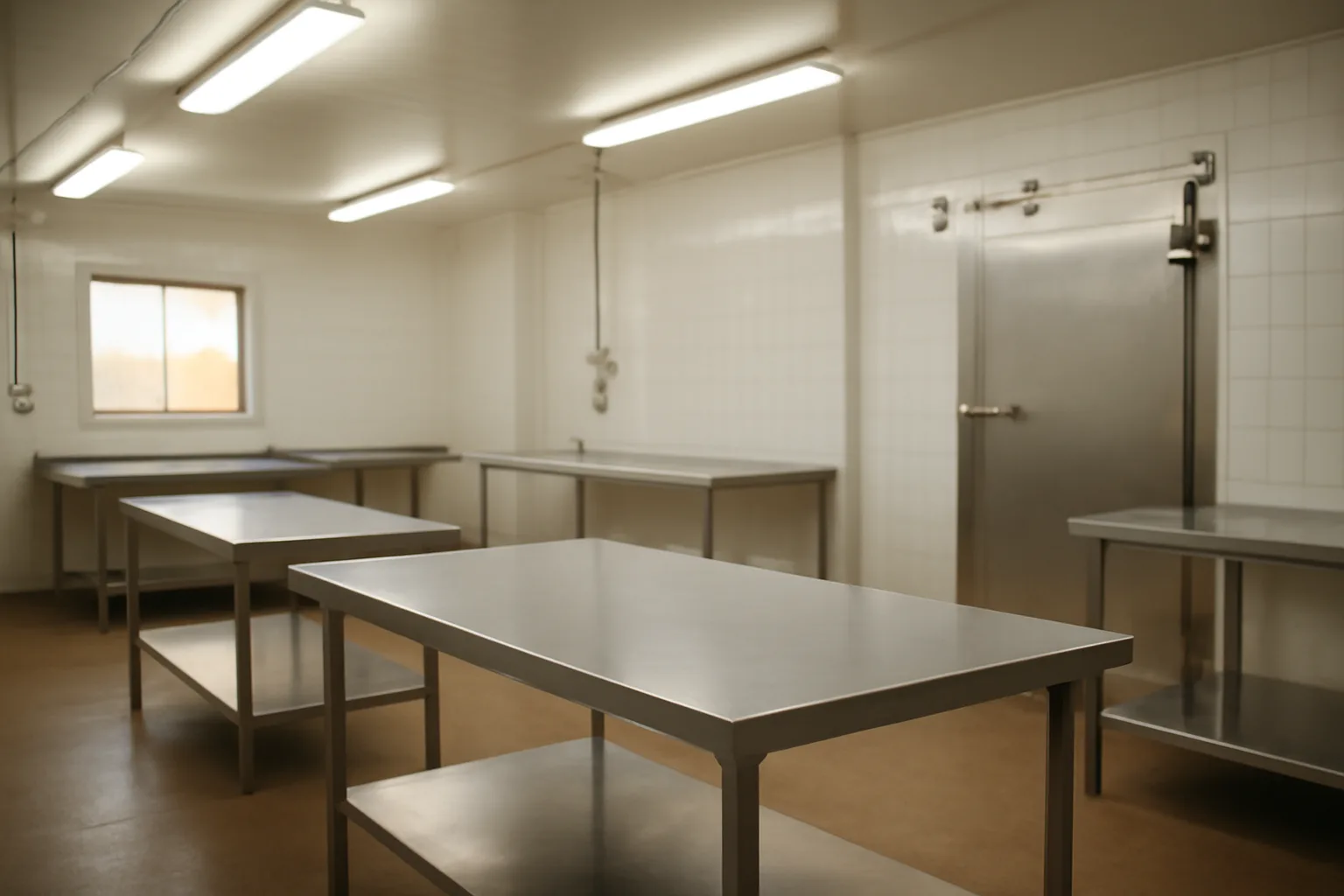
Facility construction: walls, floors, and ceilings must be smooth, impervious, and cleanable. No bare wood in processing areas. Adequate lighting (at least 50 foot-candles at work surfaces). Separate rooms or areas for receiving, processing, and storage.
Temperature control: carcasses must reach 40°F or below within a defined time, and your cooler must hold that temperature reliably. In an Arizona summer that means a well-sized refrigeration system, not a residential chest freezer.
Water supply: potable water, hot and cold, with adequate pressure, from a licensed well or municipal source.
Pest control: a documented pest management program.
Employee hygiene: handwashing stations reachable at every work station.
HACCP plan: most licensed facilities need a written Hazard Analysis and Critical Control Points plan. ADOA wants to see it before they issue the license [6].
Failing any one of these doesn't automatically kill your application, but it triggers a reinspection visit, which costs weeks. Get the ADOA pre-application checklist early and walk your space against it before you call for the inspection.
Does Arizona require a HACCP plan for a cut and wrap license?
Yes, with nuance. HACCP plans are required under USDA rules for federally inspected establishments, and Arizona's state-inspected program mirrors federal standards [2]. Custom-exempt facilities face a lighter version, but ADOA still expects documented food safety procedures.
A HACCP plan for a cut-and-wrap shop is nowhere near as complex as one for a cooked-product plant. The main hazards in raw meat cutting are temperature abuse and cross-contamination. Your plan names those hazards, sets critical limits (40°F or below for refrigeration, for example), describes how you monitor them, and spells out what you do when a limit gets blown [6].
Writing a basic HACCP plan from scratch takes most first-timers 8 to 20 hours of focused work. Generic templates exist, but they rarely match your floor plan or equipment, and an inspector can spot the difference between a plan built for your shop and one downloaded and barely edited.
Want a structured starting point? CutWrapPath's HACCP and Deer-Season Kit (/start) walks through plan-building for small game processors and costs $179 one-time. That's one option. USDA's HACCP Models for small processors are also free to the public [6].
Either way, have the plan drafted before you call ADOA for your pre-operational inspection.
What local permits does a cut and wrap shop need in Arizona beyond the state license?
The ADOA license is necessary but not enough on its own. You'll also need several local approvals.
Arizona business registration: operating as an LLC or corporation means filing with the Arizona Corporation Commission. The standard LLC articles-of-organization filing fee is $85 as of 2024 [4].
Local business license: most Arizona cities and some counties require a general business license. Phoenix, Tucson, Flagstaff, and Prescott each set their own rules. Fees typically run $50 to $200 a year.
Zoning approval: a meat processing facility is not welcome in every commercial zone. Confirm your location is properly zoned before you sign a lease. Call the planning department for your city or county first.
Building permits: any construction or serious renovation of a processing space needs a building permit. In Arizona, building permits fall under local jurisdiction, and the state's fire, building, and life safety framework sets baseline standards for some facility types [7].
Plumbing permit: the floor drains, commercial sinks, and grease interceptors a processing facility requires almost always trigger a separate plumbing permit.
In an unincorporated area, Maricopa County, Pima County, and Yavapai County each run their own environmental health and building departments. Rural does not mean fewer permits. In some cases the county process moves slower than a city's.
How does the Arizona game processing season affect cut and wrap operations?
Arizona Game and Fish manages deer, elk, pronghorn, and javelina seasons across a complex unit system [5]. Archery deer season usually opens in August. Rifle and muzzleloader seasons run October through December for most species. Elk seasons stretch into January in some units.
For a cut-and-wrap shop, your real revenue window is about five months, and the crunch is roughly 10 to 12 weeks. That shapes how you staff, how much cooler space you need, and whether you take reservations or work walk-ins.
Arizona's game-check rules changed in recent years. Arizona Game and Fish now uses an online check-in system instead of physical check stations for most species [5]. Hunters arrive at your facility with a confirmation number on their phone, not a paper tag on the animal. Build your intake process around that. You're not the one recording kill data, but you should log the confirmation number in your receiving records for traceability.
Seasonal-only operation is possible under an ADOA license. If you want to run only during hunting season and close the rest of the year, raise it with ADOA during the application. Your license and inspection duties don't vanish in the off-season, but some operational requirements may flex around your schedule.
How does Arizona compare to neighboring states for cut and wrap licensing?
Useful context if you're near a state line or weighing where to locate.
| State | Licensing agency | Custom-exempt available? | Interstate commerce allowed? |
|---|---|---|---|
| Arizona | ADOA Animal Services | Yes | No (state-inspected only) |
| California | CDFA Meat and Poultry | Yes | No (state-inspected only) |
| Colorado | CDPHE / USDA | Yes | USDA-inspected facilities only |
| Nevada | NDOA | Yes | No (state-inspected only) |
| New Mexico | NMDOA | Yes | No (state-inspected only) |
| Utah | UDAF | Yes | No (state-inspected only) |
Arizona's program sits mid-range in complexity next to its neighbors. California is heavier on new entrants see cut and wrap license in california. Colorado's closeness to federal USDA inspectors in some rural areas gives operators there an easier path to selling interstate see how to start cut and wrap in colorado.
None of Arizona's neighbors let a state-inspected facility sell across state lines. If wholesaling to retailers in multiple states is part of your plan, you need a full USDA federal grant of inspection. That's a separate and more demanding process than the state license.
What are the most common reasons Arizona cut and wrap applications get delayed?
Working from the public record of ADOA inspection requirements and what USDA documents about small processor pitfalls nationally [6], the pattern holds steady. Here are the real delay drivers.
Incomplete application: a missing equipment list, facility diagram, or water test result means ADOA can't schedule your pre-operational inspection. They hold the file until it's complete.
Facility diagram too thin: ADOA needs a floor plan showing product flow, the location of sinks, coolers, and drains, and the separation between processing and receiving areas. A sketch on notebook paper won't pass.
Cooler temperature failure: a walk-in that can't reliably hold 40°F fails inspection. In Arizona, undersized refrigeration is a real risk given summer ambient temperatures.
HACCP plan gaps: a plan that names hazards but skips critical limits or corrective actions is incomplete.
Local permit delays: ADOA won't issue a final license until the facility is legal to operate at the local level too. A pending building permit can stall your state license.
The fix for all of these is preparation before you submit. Walk the application checklist against your facility. Get your plan written and reviewed by someone who has built one before. Have a plumber confirm your drains and water connections meet commercial food-facility standards before the inspector arrives.
Where do you actually apply for a cut and wrap license in Arizona?
The application goes through the ADOA Animal Services Division. You reach them through the Arizona Department of Agriculture's official website [1]. As of 2024, ADOA has moved much of its licensing paperwork online, but some first contact still happens by phone or email, especially for first-time applicants who need a pre-application meeting.
A pre-application meeting with an ADOA inspector, before you build out your facility, is worth the time. Inspectors tell you site-specific things no article can: whether your proposed floor drain location works, whether your cooler door clearance is adequate, whether your water heater has the capacity for your planned throughput. One conversation can save you a failed inspection.
For the full picture of how to structure your business and timeline from day one, see how to start cut and wrap in Arizona. That companion guide covers the whole launch sequence, well beyond the license.
CutWrapPath's materials are one resource for HACCP plan templates and deer-season operational checklists (/start). The ADOA application itself and any fees come directly from the agency.
Frequently asked questions
Do you need a license for cut and wrap in Arizona?
Yes. Arizona law under A.R.S. Title 3, Chapter 6 requires any establishment that processes meat or poultry for human consumption to hold a state license from the Arizona Department of Agriculture's Animal Services Division. This applies to custom-exempt shops (processing for the animal's owner only) and to fully inspected facilities. No license means no legal operation, regardless of volume.
What is the custom-exempt exemption and does it apply to deer processing in Arizona?
The custom-exempt category covers facilities that process animals owned by the customer and return all product to that same customer, with nothing entering commerce. Most Arizona deer processors run under this exemption. You still need a state license and must pass ADOA inspection. You don't need the federal mark of inspection, but your product can't be sold to anyone.
How much does cut and wrap cost in Arizona for a license?
Arizona's establishment license fees are tiered by volume and category. Publicly available information suggests fees in the range of $150 to several hundred dollars per year, but fees change and you must confirm the current amount directly with ADOA's Animal Services Division. Beyond the license, expect significant capital costs for refrigeration, equipment, and facility improvements.
How long does it take to get a cut and wrap license in Arizona?
Most complete applications move through ADOA review and pre-operational inspection in 4 to 8 weeks. An incomplete application or a failed inspection resets that timeline. To open for Arizona's archery deer opener in August, submit your application in the spring. Local building and zoning permits can add weeks outside ADOA's control.
Does Arizona require a HACCP plan for a cut and wrap license?
Yes. Arizona's state inspection program mirrors federal USDA standards, which require a written HACCP plan identifying food safety hazards, critical control points, and corrective actions. For a raw-meat cut-and-wrap shop the plan is relatively simple, centered on temperature control and cross-contamination prevention, but it must be specific to your facility and equipment.
Can I process deer out of my home in Arizona?
No. A residential kitchen does not meet Arizona's facility sanitation requirements for a licensed meat establishment. You need a purpose-built or commercially renovated space with smooth impervious surfaces, commercial refrigeration, potable hot and cold water, proper drainage, and an ADOA-approved layout. Arizona's cottage food law does not cover meat products.
Can an Arizona cut and wrap shop sell meat across state lines?
No. An Arizona state-inspected establishment cannot sell meat in interstate commerce. To sell wholesale across state lines, you need a USDA federal grant of inspection, which requires meeting federal standards and having federal inspectors on-site during operations. That is a separate, more demanding process than the state license.
What equipment is required to pass ADOA inspection?
At minimum: a walk-in cooler that holds carcasses at 40°F or below, a commercial meat saw or band saw, stainless-steel work tables, handwashing sinks at every work area, a potable hot and cold water supply, floor drains, and adequate lighting (at least 50 foot-candles at work surfaces). Exact specs depend on your facility size and volume; ADOA inspectors review your equipment list during the pre-operational inspection.
Do I need a local business license in addition to the ADOA license?
Almost certainly yes. Most Arizona cities require a general business license, and some counties do too. You also need zoning approval confirming your location is permitted for meat processing. Check with your city or county planning and business licensing departments before committing to a location. The ADOA license and the local business license are separate requirements from separate agencies.
How does Arizona Game and Fish check-in affect my cut and wrap intake process?
Arizona Game and Fish uses an online check-in system for most species. Hunters arrive with a digital confirmation number rather than a paper tag on the animal. Your intake process should record that confirmation number in your receiving log for traceability. You aren't responsible for submitting game data, but logging the confirmation number protects you if questions come up about the legality of an animal brought to your facility.
Can I operate a cut and wrap shop seasonally in Arizona?
Seasonal operation is possible under an ADOA license. If you plan to process only during hunting season and close the rest of the year, raise it with ADOA during your application. Your license and inspection obligations remain; you can't simply stop paying and restart without re-applying. Some operational requirements may be structured around your actual operating schedule.
What is the difference between a state-inspected and USDA-inspected cut and wrap facility in Arizona?
A state-inspected facility holds a license from ADOA and operates under Arizona's Meat and Poultry Inspection Act, which meets and mirrors federal standards. Product from that facility can only be sold within Arizona. A USDA-inspected facility holds a federal grant of inspection, has USDA inspectors on-site during operations, and can sell product across state lines. Most small Arizona cut-and-wrap shops run under state inspection.
Are there any Arizona cut and wrap exemptions for very small volumes?
Arizona has no blanket low-volume exemption that removes the licensing requirement. The custom-exempt category is the closest thing: it drops the need for the full mark of inspection, but it still requires a state license and facility inspection. There is no threshold below which you can skip the license entirely for commercial processing. If you process only your own animals for your own household, that's a different question, but any commercial arrangement requires a license.
Sources
- Arizona State Legislature, A.R.S. Title 3 Chapter 6 (Meat and Poultry Products Inspection): Arizona's Meat and Poultry Products Inspection Act, A.R.S. Title 3 Chapter 6, requires a state establishment license for any facility processing meat or poultry for human consumption
- USDA Food Safety and Inspection Service, State Inspection Programs: Arizona runs a state-inspected meat program under which state standards must be 'at least equal to' federal requirements under the Federal Meat Inspection Act
- USDA FSIS, 9 CFR Part 416 Sanitation Performance Standards: Federal Sanitation Performance Standards, which Arizona mirrors, require potable water, adequate refrigeration holding carcasses at 40°F or below, smooth impervious surfaces, proper drainage, and pest control programs
- Arizona Corporation Commission, official website: Arizona LLC articles-of-organization filing fee is $85
- Arizona Game and Fish Department, Hunting and Game Check-in: Arizona Game and Fish manages deer, elk, pronghorn, and javelina seasons by unit and uses an online check-in system for most species
- USDA FSIS, HACCP Models for Small and Very Small Establishments: USDA requires documented HACCP plans for licensed meat establishments identifying hazards, critical limits, monitoring procedures, and corrective actions; publicly available generic models exist for small processors
- Arizona State Legislature, A.R.S. Title 41 Chapter 16 (Building Codes and Standards): Arizona's building code framework for commercial facility construction and renovation falls under local jurisdiction coordinated with state standards
- USDA FSIS, Custom and Retail Exemptions from Federal Inspection: The custom-exempt exemption allows facilities to process animals owned by the customer and return all product to that owner without the federal mark of inspection, but state licensing requirements still apply
- USDA FSIS, Federal Meat Inspection Act statutory text: The Federal Meat Inspection Act requires that state-inspected programs maintain standards 'at least equal to' federal standards; product from state-only-inspected facilities cannot enter interstate commerce