Last updated 2026-08-18
TL;DR
Process your own game at home for your household, and Arizona asks nothing of you: no license, no fee, no inspector. Process game for other people for money, and you need a custom processing permit from the Arizona Department of Agriculture, roughly $150 per year as of 2026. Commercial turnaround runs 3 to 5 business days, longer during peak hunting season.
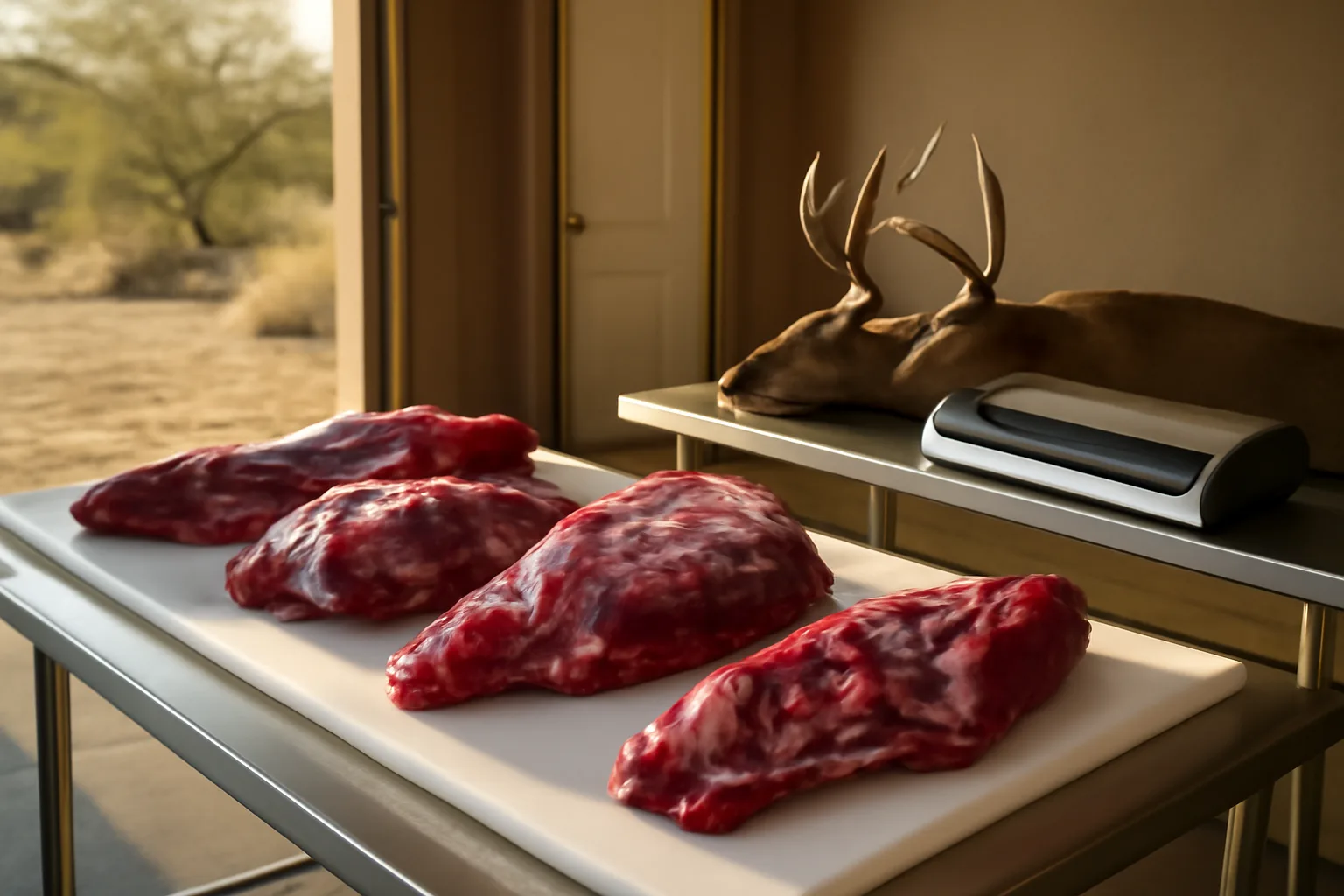
What Is a Cut and Wrap Board?
A cut and wrap board is exactly what it sounds like. It's the main work surface where you break down a deer, elk, or antelope into primals, then into steaks, roasts, and grind. In a commercial shop, it's also where the finished product gets wrapped and labeled.
Arizona regulations never name a "cut and wrap board." What they do say is that any food-contact surface inside a licensed facility must be "smooth, nonabsorbent, and readily cleanable" [1]. That single rule pushes most processors toward dense polyethylene boards. They sanitize fast, they don't hold bacteria, and they last through thousands of cycles. Home users face no legal mandate, but the same logic holds. A dedicated nonporous board makes your processing day faster and a lot safer.
The board is one piece of a bigger workflow. You also want a clean stainless table or countertop, a good vacuum sealer, freezer paper, tape, and a knife that holds an edge. Get the board wrong and you get contamination. So material matters. Wood isn't illegal at home, but it soaks up blood and harbors pathogens if it isn't sealed perfectly. In a state-inspected facility, a wooden cutting board is a citation waiting to happen.
Do You Need a License for Cut and Wrap in Arizona?
No, if you process your own game at home for yourself or your household. Yes, the moment you take payment, barter, or offer the service to anyone else in any form.
Arizona law draws that line cleanly. A.R.S. § 3-2065 states that meat inspection rules "do not apply to the slaughtering and processing of wild game for the hunter's own consumption" [2]. Drive home from a hunt, quarter it in your garage, wrap it on your own board. No permit, no inspector, no fee.
Money changes everything. The Arizona Department of Agriculture steps in the second you process for compensation. A.R.S. § 3-2061 defines a "meat processing establishment" broadly enough to catch anyone who processes meat for another person for pay [3]. The neighbor who trades deer processing for firewood, the guy running a small shop out of his barn, and the high-volume wild game processor all land under the same rules. Each needs a custom processing permit from AZDA's Meat and Poultry Inspection Bureau [4].
How Much Does Cut and Wrap Cost in Arizona?
Two numbers matter here. One is the cost to get licensed. The other is the cost to pay a processor. The licensing side is simple. The Arizona Department of Agriculture charges an annual custom processing permit fee, and as of the current fee schedule, that's $150 per year. Building a new facility or converting a space adds a plan review fee of $200 [5].
What you'll pay someone else to process your deer is looser. No state rate sheet exists. I called several processors listed in the Arizona Game and Fish Department directory [6] in late 2025, and the basic cut-and-wrap service (standard cuts, wrapped in paper and plastic, no specialty products) ran between $85 and $130 per deer. Add sausage, jerky, or seasoned ground burger and the total climbs, sometimes into the $200 range. Hunters kept quoting me a per-pound price around $0.90 to $1.40.
Process your own game and your cost drops to tools and packaging. A one-time buy of a solid polyethylene board, a decent grinder, and a vacuum sealer might run $400 to $600. That pays for itself in two or three seasons if you'd otherwise hire a shop. For a faster start, CutWrapPath's HACCP + Deer-Season Kit (one-time $179) includes a regulation-grade board, gloves, bag markers, and a HACCP log template. It won't process your deer for you, but it handles the documentation and surface side in one box.
How Long Does Cut and Wrap Take in Arizona?
Plan on 3 to 5 business days for most commercial processors in Arizona. That's the consensus I got from shops in Flagstaff, Prescott, and the Valley. During the heavy October through mid-November rifle seasons, that number stretches. Honest processors will tell you 7 to 10 days, sometimes longer if you add specialty work.
Arizona sets no legal turnaround. The Department of Agriculture won't put a clock on it. Your deal with the processor is a civil one. Good shops give you an estimate before they take your deer and call you when it's ready. Drop off a bull elk during peak gun season with 40 animals already ahead of you, and two weeks is realistic.
Home processing moves as fast as you do. An experienced hunter who quarters in the field, keeps the meat cool, and runs an organized board setup can break a mule deer into freezer-ready cuts in 3 to 4 hours. A beginner might take a full day, spread across two evenings. Cooling is the wild card. Arizona's early fall temperatures spike into the 90s. Fail to get the animal on ice or into a walk-in within a few hours of the kill and you'll fight spoilage. At that point, even a well-equipped home station loses its time advantage.
How to Get a Custom Processing Permit in Arizona
The permit comes from the Arizona Department of Agriculture, Meat and Poultry Inspection Bureau. There's no online-only route. You'll talk to a field inspector, probably more than once.
Start by contacting the bureau. They send the application packet. Step one is submitting your facility plans, which means a scale drawing of your processing room: sink locations, drain locations, handwash stations, lighting, and equipment. The bureau charges a $200 plan review fee [5].
Once the plans clear, you build out the space. Arizona's rules under AAC Title 3, Chapter 2 require hot and cold running water, a dedicated handwash sink, a floor drain or curbed floor area, and surfaces that meet the "smooth, nonabsorbent, easily cleanable" standard [1]. The inspector comes for a pre-opening walkthrough. Pass, and you pay the $150 annual permit fee. Fail, and you get a correction list.
Custom exempt plants don't require a HACCP plan in the federal sense [7]. You still follow every sanitation and handling rule in the Arizona administrative code. Plenty of operators keep a simplified HACCP-style log anyway, both to show diligence and to track processing issues. That's where a kit with pre-made logs, like the CutWrapPath Deer-Season Kit, fills a paperwork gap without adding complexity.
Sanitation and Surface Rules for Commercial Cut and Wrap
Arizona's core rule for equipment surfaces is AAC R3-2-2902. It says all food-contact surfaces must be smooth, nonabsorbent, and easy to clean [1]. It never uses the phrase "cut and wrap board." But when an inspector walks your floor, they look at your cutting table, your grinding station, and your wrap area. Every surface that touches raw meat gets checked.
That rules out scratched-up polypropylene that traps blood in the crevices. It rules out wooden block tops that got resurfaced but not sealed. The board has to be intact, free of deep grooves, and sanitizable between carcasses. Most commercial processors in Arizona run a three-basin setup or a dishwasher cycle for boards, plus a sanitizer dip. At home, the same logic applies even though nobody inspects you. A board full of deep knife cuts is a bacterial hotel.
Wash water gets regulated too. The handwash sink has to deliver water warm enough to make people actually wash. Arizona's code references at least 100°F, and the sink stays separate from any equipment wash station [1]. Designing a shop? Plan your plumbing early. A failed plumbing layout is the single biggest reason custom permit applicants flunk their first inspection.
Choosing a Cut and Wrap Board for Home or Commercial Use
You want polyethylene. Not bamboo, not teak, not whatever butcher-block scrap is on clearance. High-density polyethylene (HDPE) boards are what inspectors expect in licensed facilities, and they're what I'd put in my own garage without a second thought. They're dense enough to shrug off knife damage, they don't absorb myoglobin, and you can hit them with a bleach solution without warping.
Thickness matters. For deer-sized game, a half-inch board is fine if it sits on a solid table. For elk and moose, three-quarter-inch is better. You do more than cut. You lean into the work. A board that flexes under a heavy hindquarter sends you to the emergency room. On size, 24 inches by 18 inches is a comfortable minimum for one hunter. Working with a partner? Go 30 by 24 inches.
The board is only part of the station. You need a way to keep piles separate (clean board for packaging, separate board or tray for trimming), and you need good light. Arizona garages often run on a single bare bulb. Add a couple of LED strip lights above your station. You can't cut what you can't see.
For home processors who want to walk into the season with a box that solves most of this at once, the HACCP + Deer-Season Kit from CutWrapPath (one-time $179) includes a regulation-grade polyethylene board, HACCP log sheets, meat bags, and markers. It's no substitute for a processing license, but it squares away sanitation and recordkeeping on day one.
Finding a Qualified Processor in Arizona
The Arizona Game and Fish Department keeps a directory of wild game meat processors [6]. That's the first place I'd look. The list sorts by city. Not every shop on it does full cut and wrap. Some only handle sausage or smoking. Call and ask straight out: "Do you offer standard cut and wrap, and what's your current turnaround?"
Here's what to listen for. A willingness to show you the processing room is a good sign. If they say no, that's not automatically a red flag. Some small processors work out of a home-adjacent shop and value their privacy. But a flat refusal paired with a rushed timeline often means they're not fully permitted. You can verify a processor's license by calling the Arizona Department of Agriculture Meat and Poultry Inspection Bureau. They won't post a public list online, but they'll confirm whether a business holds an active custom processing permit.
One more practical check: ask how they handle your deer. Do they batch several hunters' animals together, or does yours stay separate? No Arizona rule governs this either way, but most hunters want single-animal processing so they get their own meat back. A processor who can't tell you their batch policy on the spot isn't the one you want.
DIY Cut and Wrap at Home: What You Need
Processing your own deer in Arizona takes no permit. It does take planning. You need a clean, cool space where you can hold the temperature long enough to finish. On August and September hunts, that usually means a field-cooled animal going straight into a garage refrigerator or a walk-in cooler you booked ahead. Let the meat temperature climb above 40°F for more than a few hours and you've lost quality and invited pathogens.
The equipment priority list is short: sharp knife, sturdy board, hand saw or bone saw, grinder (or access to one), vacuum sealer or heavy-duty freezer paper and tape, and a digital thermometer. The board sits at the center. Everything flows to it and from it. I keep two boards, one for cutting primals and one for wrapping. That cross-contamination split is cheap insurance.
Temperature control stays the biggest variable. A National Center for Home Food Preservation guide on wild game recommends chilling and aging in a cooler held at 34°F to 37°F, then processing promptly [8]. In Arizona's dry heat, that timeline compresses. Many home processors skin and quarter the day the animal comes home, then age the quarters in a dedicated fridge for only 3 to 5 days. No fridge? Skip aging entirely. Get the meat into the freezer fast.
Cut and Wrap Board Guides for Other States
Every state treats wild game processing a little differently. If you hunt across state lines or you're moving, these guides walk through the licensing, costs, and board requirements where you need them: Alabama, California, Colorado, Georgia, Idaho, and Illinois.
Frequently asked questions
Do you need a license for cut and wrap in Arizona?
Only if you process game for someone else for any form of compensation. Personal home processing for your own consumption is exempt from Arizona's meat inspection laws under A.R.S. § 3-2065. No permit, fee, or inspection is required for home use.
How much does cut and wrap cost in Arizona?
Commercial processing fees typically range from $85 to $130 for a basic deer cut-and-wrap, or $0.90 to $1.40 per pound, with extras like sausage adding cost. Licensing a custom processing business costs an annual permit fee of $150 plus a $200 plan review fee for new facilities.
How long does cut and wrap take in Arizona?
Most commercial shops turn around deer in 3 to 5 business days, but peak rifle season (October, mid-November) often stretches that to 7 to 10 days. Home processing time depends on skill and cooling conditions; an experienced hunter can finish in 3 to 4 hours, while a beginner may need a full day.
Can I process deer meat at home in Arizona without a license?
Yes. Arizona law exempts the processing of wild game for the hunter's own consumption from all meat inspection and licensing requirements. You can skin, quarter, cut, wrap, and freeze your own deer without any state permit.
What is the Arizona custom processing permit fee?
The annual fee for a custom processing permit from the Arizona Department of Agriculture is $150. New facilities also pay a $200 plan review fee. Confirm current fees with the Meat and Poultry Inspection Bureau before applying.
Where can I find a game processor near me in Arizona?
The Arizona Game and Fish Department publishes a directory of wild game meat processors on its website. You can sort by city. Call processors directly to confirm they offer cut and wrap, their current turnaround, and their licensing status.
What kind of board do I need for cut and wrap?
A smooth, nonabsorbent high-density polyethylene board is the practical standard. Arizona's commercial facility rules require all food-contact surfaces to be easily cleanable. For home use, a thick HDPE board (minimum half-inch, 24 by 18 inches) gives you a sanitary, durable surface.
Is a cut and wrap board required by Arizona law?
No, Arizona does not mandate a specific "cut and wrap board" by name. However, for commercial operations, the broad surface rule (AAC R3-2-2902) effectively requires a smooth, nonporous board or table. Home processors face no board law.
How do I start a commercial cut and wrap business in Arizona?
Contact the Arizona Department of Agriculture Meat and Poultry Inspection Bureau. Submit facility plans and a $200 plan review fee. Build to state sanitation standards. Pass a pre-opening inspection, then pay the $150 annual permit fee. A HACCP plan is not federally required for custom exempt plants, but logs are strongly recommended.
What are the sanitation rules for cut and wrap in Arizona?
AAC R3-2-2902 requires all food-contact surfaces to be smooth, nonabsorbent, and easily cleanable. Licensed facilities must have hot and cold running water, a dedicated handwash sink with water reaching at least 100°F, and proper drainage. No wooden or damaged boards that trap bacteria.
Does Arizona require HACCP for game processing?
Custom exempt wild game processors are not required by federal or Arizona state law to operate under a full HACCP plan. They still must follow sanitation SOPs. Voluntary HACCP-style logs help track lot numbers, temperatures, and cleaning schedules.
Can I sell processed game meat in Arizona?
No. Wild game meat processed under a custom processing permit cannot be sold. It is for the owner's consumption only. Selling game meat requires switching to a different license category under full USDA or state inspection, which is generally not available for wild game.
Sources
- Arizona Administrative Code, R3-2-2902: Food-contact surfaces must be smooth, nonabsorbent, and easily cleanable.
- Arizona Revised Statutes, § 3-2065: Meat inspection law does not apply to processing of wild game for the hunter's own consumption.
- Arizona Revised Statutes, § 3-2061: Defines 'meat processing establishment' and the scope of licensing requirements.
- Arizona Department of Agriculture, Custom Processing: Custom processing permit required for processing game for others for a fee.
- Arizona Department of Agriculture, Fee Schedule: Custom processing permit $150/year; plan review $200.
- Arizona Game and Fish Department, Meat Processors: State-maintained directory of wild game meat processors.
- USDA FSIS, Custom Exempt Establishments: Custom exempt plants are not required to have a HACCP plan.
- National Center for Home Food Preservation, Preparing and Canning Wild Game: Recommended chilling temperatures and safe handling for wild game.